Ah Birmingham, the disputed UK second city (by Manchester), a place with more canals than Venice and a once mighty centre of engineering. It is, too, the most inland place in the UK (furthest from any coast), so it came as something of a surprise to the team at HSEQ-360 Limited to see an article espousing the Birmingham Blade.
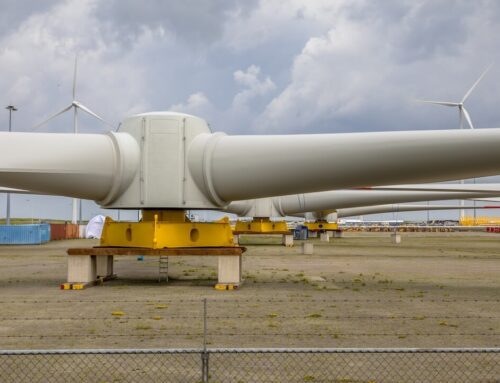
What’s perhaps more expected (given its geographical location) is that this an urban wind turbine and has been designed by AI.
AI does have a long (albeit recent) history, dating back to 1943 when Warren McCulloch and Walter Pitts proposed the first mathematical model of a neural network, laying the groundwork for it..
AI is something that is now growing at an exponential rate – Apple has recently introduced Apple Intelligence to its newer devices but many see it as half-baked. ChatGPT is integrated into Siri as is their version of Google Lens.
But back to the Birmingham Blade, as we digress
Being so inland and with low wind speeds, the city needed a solution that would generate electricity at 3.6 metres per second (10 seconds is the norm for most turbines). The city centre does have wind turbulence too, caused by the funnelling of winds between tall buildings. It had to have a small footprint so it could be installed on rooftops.
EvoPhase determined via AI that curved blades, spinning around a central point, would meet the city’s design needs. AI, with no design biases, allowed the developers to think afresh away from traditional turbine manufacture and the Birmingham Blade is now born, after 2,000 prototypes were tested via AI.
What’s gratifying too to see is the collaborative work carried out here – this was conjoined design created by Kwik Fab, EvoPhase and the University of Birmingham.
“We can take a complex design, and manufacture and ship a prototype for testing within weeks. We’d like to work with organisations that want to make the most of wind power, a source of sustainable energy that is free and present in every country” Paul Jarvis, Kwik Fab
The Birmingham Blade is expected to be rolled out in early 2025, and modified versions are being looked at for other cities, like Edinburgh, with its own harsher weather conditions.
In Norfolk and Suffolk, we are surrounded by beautiful coastlines and marshy countryside. Winters here are cold and harsh, wind speeds can be high and the climate is dry all year round. We don’t have towns or cities on the scale of Birmingham, with Norwich and Ipswich being the biggest places. Norwich only has a handful of towers – the most notable being Westlegate Tower and turbulence isn’t an issue.
But it does have a growing population and is a city that would benefit from compact, green turbines, like the Birmingham Blade, perhaps.
City of 1,000 Trades
Birmingham earned this nickname in the 19th century due to its wide range of skilled trades and industries. Perhaps now they can change their name to 1001 trades?
How HSEQ-360 Limited can help your offshore company
HSEQ-360 Ltd utilise a team with wide ranging skills, competencies and experiences; including chartered engineers, chartered health and safety and chartered quality professionals. HSEQ-360 can certainly review your company’s operations and management systems and implement sustainability strategies which are reasonable and practicable for your business.
We operate a management system which is certified to ISO9001, ISO14001 & ISO45001; and we are specialists in developing bespoke management systems for your business. We can complete an environmental impact on your behalf and can provide practical recommendations on how to proceed environmentally.
For further information, please see our website, follow our active LinkedIn channel, or contact a member of the team on info@hseq-360.co.uk