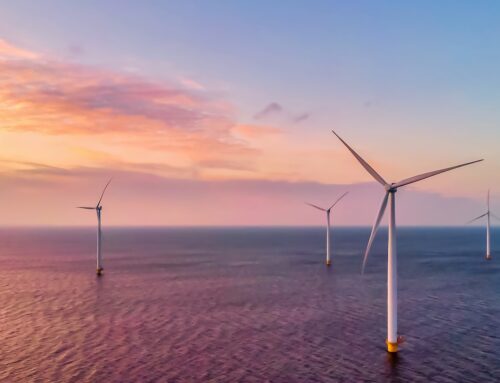
Twenty five years ago, in December 2000, something quietly revolutionary happened off the coast of Blyth, Northumberland. Four turbines rose from the seabed, experimental, exposed and entirely untested at this scale in UK waters. Few people onshore had any sense that these machines would become the catalyst for one of the most important infrastructure transformations in modern British history.
But they did
And the work that companies like HSEQ-360 Limited now lead across today’s major offshore wind projects can be traced directly back to this moment.
What happened at Blyth was more than the construction of a small demonstration site. It was a statement of intent. A belief that offshore wind could move from the fringes of engineering theory to the forefront of national energy strategy. When those turbines switched on, the UK stepped into a cleaner, more resilient future.
Fast-forward to today
Offshore wind has evolved from a pioneering experiment into the second largest power source in the UK after gas. The statistics alone show how far the sector has come: forty seven operational offshore wind farms now supply around seventeen per cent of Britain’s electricity generation and support an estimated forty thousand jobs. This is no longer a side industry.
Energy Minister Michael Shanks described offshore wind as “the backbone” of the UK’s future grid, and he is not wrong. The engineering, safety frameworks, supply-chain coordination and robust governance that underpin this momentum are now central to national policy, and they are the exact domains in which HSEQ-360 Limited operates.
Ensuring safety, compliance, operational readiness and high-risk project assurance across both onshore and offshore phases is no longer optional. It is the difference between ambition and delivery.
At Blyth, nobody fully understood the scale of what would follow
Today, the sector is a masterclass in engineering ambition, regulatory sophistication, and rapid expansion. And as Labour drives forward with its commitment to remove almost all fossil fuels from the UK’s electricity supply by 2030, the onshore groundwork, HSEQ frameworks and risk-management disciplines delivered by organisations like HSEQ-360 Limited have never been more pivotal.
The industry talks a lot about innovation, speed and scale
But none of that momentum is sustainable without fully integrated HSEQ thinking.
- Safe mobilisation
- Structured governance
- Stronger assurance
- Clearer pathways from concept to commissioning.
These are the systems that keep progress on track. These are the systems that ensure offshore wind remains not just bold, but safe, compliant and future-ready.
Blyth was the spark. HSEQ-360 Limited supports the machinery of progress that keeps that spark burning.
To give some perspective to how long a time period 25 years is, take a look at this facts from the year 2000.
- The Millennium Dome opened in London, drawing millions of visitors during its landmark year
- London’s Millennium Wheel began official operation, becoming a global icon
- The first series of Big Brother aired in the UK, transforming the landscape of reality television
- Ken Livingstone became the first Mayor of London, following the introduction of the new mayoral system
- The Tate Modern opened, redefining Southbank and putting London at the centre of contemporary art
- Fuel protests brought Britain’s roads to a standstill, highlighting national dependence on energy supply
- The Hatfield rail crash prompted far-reaching safety reforms across the rail network
- BT Cellnet launched the UK’s first commercial GPRS mobile service, early groundwork for the smartphone era
- Manchester United won the Premier League for a sixth time, dominating English football at the turn of the millennium
- The Teletubbies caused a national merchandise frenzy, with Po outselling all other characters by a mile
Looking ahead, the strength of the UK’s offshore wind future will rest on the same principle that guided Blyth: progress built on safe, assured and trusted foundations.
HSEQ-360 Limited aim to be at the vanguard of that progress.