Written Schemes of Examination under The Pressure Systems Safety Regulations. Is a Pressure Gauge a Protective Device?
HSEQ-360 Limited author Written Schemes of Examination under LOLER 1998 and PSSR 2000 for a range of clients, from offshore wind farm owners to top tier COMAH sites. Under LOLER, this typically includes Service Lifts and Davit Cranes, and under PSSR would encompass a hydraulic system consisting of a high-speed brake, yaw brake, hatch, and pitch systems.
We believe our approach to Written Schemes of Examination is unique, calling upon a Chartered team of professionals across Asset Integrity, Metallurgy, Corrosion, Quality and Health and Safety. Written Schemes of Examination are also within the scope of our UKAS-accredited ISO certification.
Many Written Schemes of Examination under PSSR (incorrectly) require testing, examination and calibration of every pressure gauge forming part of a pressure system.
So, why is this wrong?
Regulation 2 of the Pressure Systems Safety Regulations (PSSR) says:
“protective devices” means devices designed to protect the pressure system against system failure and devices designed to give warning that system failure might occur and include bursting discs.
The PSSR ‘Approved Code of Practice and Guidance’ elaborates:
‘Protective device’ includes any protective control or measuring equipment which is essential to prevent a dangerous situation from arising. Instrumentation and control equipment would be classed as a protective device in the following situations:
(a) where it has to function correctly to be able to protect the system; and
(b) where it prevents the safe operating limits being exceeded in situations where no other protective device is provided (for example, where the relevant fluid is so toxic that it cannot be released to atmosphere). In these cases, the control equipment is itself the protective device.
Protective devices which protect a system which contains or is liable to contain a relevant fluid are covered by the Regulations even if they are located on a part of the system which does not contain a relevant fluid.
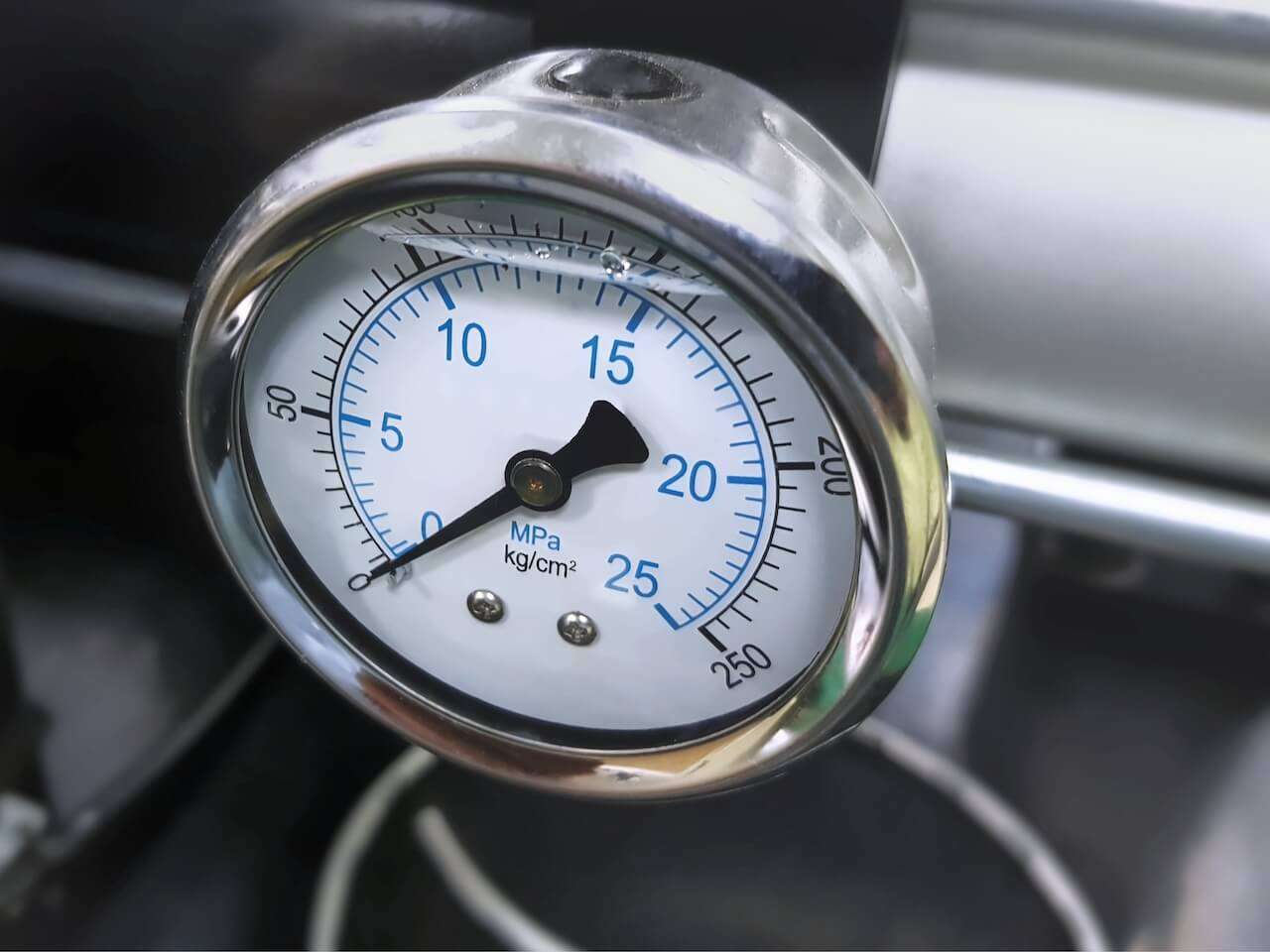
So, a pressure gauge could be a protective device, but the above suggests that control systems are more clearly defined as protective devices. As a protective device is ‘essential’ to prevent a dangerous situation occurring, this rules out most pressure gauges. A pressure gauge does exactly that; gauges pressure. It does not act or respond in order to prevent.
We’ve also seen cases where not only pressure gauges have been included in Written Schemes of Examination as ‘protective devices’, but instances where a ‘Notification of Imminent Danger’ has been issued under Regulation 10 of PSSR with a pressure gauge being marginally out of calibration. Generally, this is an insignificant risk.
Again, the wording of the legislation is key, stating “gives warning that system failure could occur”. For the most part, pressure gauges indicate pressure, and are not a ‘protective device’ that ‘gives warning’. There are numerous examples available, such as dust extraction air receivers, generally installed at height. An operator would not be reasonably expected to climb to check the pressure, and neither would the gauge give a warning that a failure may occur.
However, some pressure gauges should be in scope of a Written Scheme of Examination, as per Regulation 11. In many cases, there is then an assumption that the Operator knows what they are looking for.
Likened to the Speedometer in a car, it will give the speed of the car, but it takes interpretation and action from the driver to bring the speed of the car in line with the speed limit.
Pressure gauges exist for good reason but committing a User / Owner to potentially unnecessary costs, by taking a blanket approach, is not the purpose of a Written Scheme of Examination.
The home for the pressure gauge that is not a protective device is PUWER.
For further information on our range of services, please see www.hseq-360.co.uk, contact a member of the team on info@hseq-360.co.uk or call on 01493 446595.