Hopefully not a long-winded blog post from HSEQ-360 Limited, though the history of wind power dates back to longer than you probably realised.
It is a naturally free resource and in our corner of the UK – East Anglia – wind is a constant climatic force.
The first historical evidence of wind power dates back to 5,000 BC when boats were propelled by sails along the river Nile, with debate also centring on whether the Nile has a greater length than the Amazon (the river, not the Jeff Bezos’ giant). It flows through 11 countries and has two main tributaries that form the Nile: the White Nile and the Blue Nile.
Wind-powered water pumps are ancient too: China saw its first in 200 BC
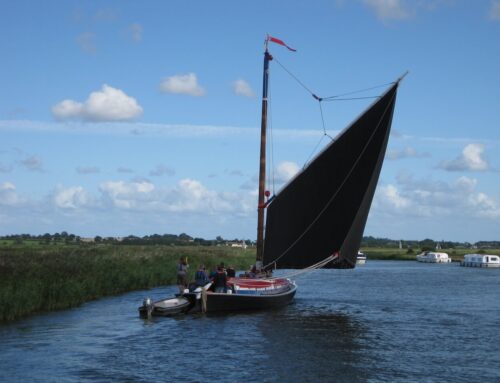
The first windmills (as Donald Trump disparagingly refers to wind turbines) appeared in the 12th century, used primarily for grinding flour and, as we’ve posted this week, on our LinkedIn page, historic and listed windmills dot the East Anglian landscape, like Bircham, the Horsey Wind Pump and across the Norfolk border in Suffolk: Herringfleet, a smock mill.
Close to this (and with little relevance perhaps to wind energy) Sir Christopher Cockerell (1910 – 1999) invented the hovercraft and tested his designs in Somerleyton, Suffolk.
The Halladay windmill
Daniel Halladay and John Burnham founded the US Wind Engine and Pump Company in Illinois in the 1850s; with the Austrian Josef Friedlander regarded as the first person to create a wind generator in 1883.
How did the first wind turbine operate?
The Halladay windmill was equally innovative and revolutionary. This self-sufficient windmill automatically turned to face changing wind directions, in addition to maintaining an even speed by changing the pitch of the sails.
As stated in the New-York Tribune in 1854:
“The wind wheel is ten feet and it has been in operation for six months without a hand being touched to it to regulate the sails.”
The windmill drew water from a well 28 feet deep, a useful tool for farming and garden irrigation.
The Halladay windmill had a secure vane and four compact blades mounted on the main shaft. To produce the greatest amount of power, the vane kept the wheel of the blades facing the wind at a specific angle.
Very clever indeed.
Onshore wind farms, as we know them, began in 1980
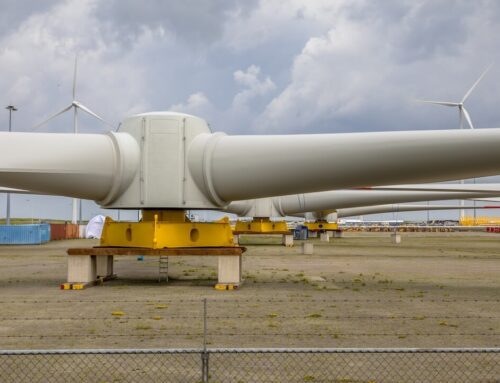
Moving on to wind farms, they’re a relatively recent invention when, in 1980, 20 wind turbines generating 30KW each, were installed in New Hampshire, onshore.
Offshore wind farms began in 1991
The first offshore wind farm appeared in Denmark in 1991 with a 5 MW capacity powering 2,200 households with green energy.
Twelve years later, in 2003, the first offshore UK wind farm appeared called “Blyth” and, perhaps confusingly, was in north Wales, not Northumberland, as its name suggests. It was the world’s biggest too at the time. This first offshore wind farm is in fact named after James Blyth, who invented the first windmill for electricity, in 1887, no less.
Stellar offshore growth in UK offshore wind production
The UK saw gargantuan growth from 2003 to 2008, as much of the Blyth engineering and technology was blithely adopted. So much so that in 2020 alone, energy harnessed from green sources accounted for a world-beating 43% of energy accrual.
The future is green, not orange?
Despite the negativity from the new POTUS, the UK government aims to deliver 50 gigawatts (GW) of offshore wind by 2030.
Windmills or offshore wind farms have a very bright future globally and our team are very excited about the present and the future.
How HSEQ-360 Limited can help your offshore company
HSEQ-360 Ltd utilise a team with wide ranging skills, competencies and experiences; including chartered engineers, chartered health and safety and chartered quality professionals. HSEQ-360 can certainly review your company’s operations and management systems and implement sustainability strategies which are reasonable and practicable for your business.
We operate a management system which is certified to ISO9001, ISO14001 & ISO45001; and we are specialists in developing bespoke management systems for your business. We can complete an environmental impact on your behalf and can provide practical recommendations on how to proceed environmentally.
For further information, please see our website, follow our active LinkedIn channel, or contact a member of the team on info@hseq-360.co.uk